
Date:
Location:
Title:
Two Extremes of Liquid-Liquid Phase Separation in Membranes: Minimal, Artificial Membranes with Two Lipids Versus Living, Biological Membranes with Hundreds of Components
Amidst longstanding excitement about liquid–liquid phase separation in biological contexts, fundamental questions have persisted about exactly which molecules are required for this transition in lipid membranes. The Keller Group applies those questions to both artificial and biological membranes. In simple membranes, enormous progress has been made in understanding large-scale, liquid-liquid phase separation in membranes with as few as three components: a sterol, lipid with ordered chains, and a lipid with disordered chains. How low can we go? Are three components really necessary? Our group set out to discover a truly minimal system with only two components. Inspired by reports that sterols interact closely with lipids with ordered chains, we found that phase separation can robustly occur in bilayers in which a sterol and lipid are replaced by a single, joined sterol–lipid. Next, we turned our attention to natural membranes. Micron-scale liquid-liquid phase separation occurs in vacuole membranes of budding yeast (S. cerevisiae) at their growth temperature when the yeast switch from the log stage of growth to the stationary stage. The membrane phases are functionally important – they play a role in enabling the yeast to survive periods of stress. We found that yeast actively regulate this phase transition to hold the membrane transition of their membrane ~15C above the yeast growth temperature. They must do so by changing their lipidome. When yeast enter the stationary stage (and their membranes phase separate), the fraction of one lipid type (PC-lipids) doubles, and lipids of that type have higher melting temperatures, which is consistent with phase separation occurring in membranes containing a sterol, lipids with ordered chains, and lipids with disordered chains.
No expertise in yeast, lipids, membranes, or chemistry is required for this seminar.
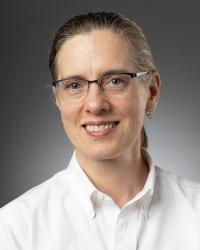
Bio: Sarah Keller is the Duane and Barbara LaViolette Professor of Chemistry at the University of Washington in Seattle. She is a biophysicist who investigates self-assembly, complex fluids, and soft matter systems. Her research group’s primary focus concerns how lipid mixtures within bilayer membranes give rise to complex phase behavior. She is a Fellow of the American Physical Society and a Fellow of the Biophysical Society.